
 EN
 Deutsch
 Español
Why Rummy Tile Game can become a new generation of classic board game
Introduction: The charm of board games and the rise of Rummy Tile Game Historical background of traditional board games Board games, as part of human...

Almost every new player asks the same question before the first tile hits the table: which way do we go? It sounds trivial, but dominoes directions decide who plays next, where a tile is allowed to land, and how a round ends. Get the flow right and the game teaches itself; get it wrong and even experienced players end up arguing about a double.
We have been moulding dominoes in Ningbo since 2008, and over the years we have shipped sets to families, game cafés, clubs and importers who all play a little differently. The rules below are the common ground most tables share, written the way we would explain them to someone opening one of our boxes for the first time.
The word covers three separate things, and mixing them up causes most of the confusion:
Once those three are clear, everything else is variation and house preference.
Place all tiles face down and shuffle them gently with the palms of your hands. Each player then draws a starting hand — seven tiles for two players, and five to seven for three or four is the usual range. The rest stay face down in the boneyard, the draw pile that keeps the game moving when someone cannot play.
For the opening tile, most tables use one of two methods. The simplest is to let the player holding the highest double start; if nobody has a double, the heaviest tile (highest total pip count) leads. The alternative is to agree that the first double played becomes the starter. Either way, settle it before the first tile is placed, not after.
Here is the core loop that most games follow:
Clockwise is the default because it matches how most people read a table, but it is not sacred. Some groups play counter-clockwise simply because that is how they learned it at home.
The chain always has two open ends, and you may add to either one. If your tile has a 4 on one half and a 6 on the other, and an open end shows a 4, you place it so the 4s touch and the 6 becomes the new open end.
A double is placed crosswise, perpendicular to the chain, so its two matching halves sit flush against the line. This is the one exception to the "lengthwise" direction rule, and it is what makes a layout readable at a glance.
Many players treat the first double as a spinner. Once both of its sides have been played off, the double itself opens two extra directions — one above and one below — so the layout can branch. Whether you allow this, and whether only the first double counts, is worth agreeing on before the round starts.
In a draw game, a player with no legal move pulls one tile from the boneyard and plays it if possible; otherwise the turn passes. In a block game, there is no drawing at all — you simply pass, and the round often ends with everyone still holding tiles.
A blocked game is not a failure. It is a legitimate finish, and at most tables the player with the lowest pip count still in hand wins the round. That single rule turns passing into a strategy rather than a formality.
Two scoring styles dominate. The simple version awards the winner the total pip count left in every opponent's hand. The more tactical version, used in All Fives and similar games, only counts totals that are multiples of five — which changes the way players hold their tiles.
Rounds usually run to an agreed target such as 100 or 150 points across several deals. Because the direction of play never changes mid-round, scores tend to stay close, and the closing tiles matter far more than early ones.
If you want the full walkthrough for the classic variant, our Double 6 rules and strategies guide goes deeper on opening moves and endgame choices.
The set you own quietly shapes the directions you can play. Larger sets open up Mexican Train and tournament play; smaller ones keep a family round tight and quick. The number of tiles follows a fixed formula, so these figures are exact.
| Set | Tiles | Highest Pip | Typical Use |
|---|---|---|---|
| Double 6 | 28 | 6-6 | Family games, travel sets, two to four players |
| Double 9 | 55 | 9-9 | Cuban dominoes and mid-size groups |
| Double 12 | 91 | 12-12 | Mexican Train and larger gatherings |
| Double 15 | 136 | 15-15 | Party play and long sessions |
| Double 18 | 190 | 18-18 | Clubs, events and tournament formats |
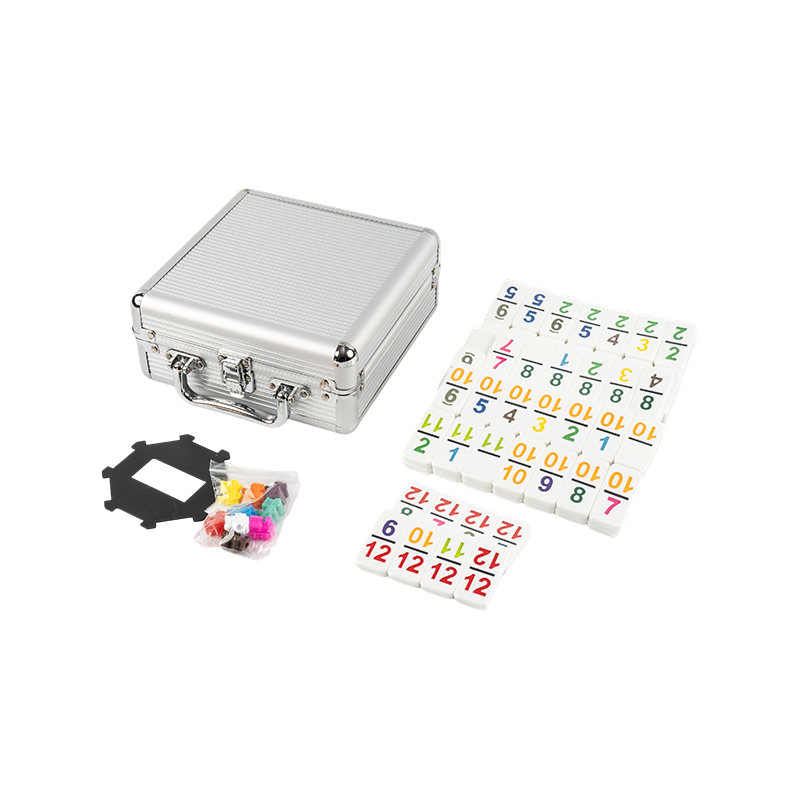 Double Twelve Aluminum Box Mexican Train DominoesA double-twelve Mexican Train set in an aluminum box, offered for OEM/ODM sourcing to extend a domino range beyond Double Six.View Product →
For buyers building a range rather than stocking one box, the practical approach is to anchor on Double 6 — it sells in almost every market — and then add Double 9 and Double 12 for players who have outgrown the beginner set. Packaging matters just as much as pip count: a tin box survives a backpack, while a wooden box turns the same tiles into a gift. If your line needs its own look, our custom domino tile options cover printed faces, colour combinations and branded packaging.
Our team has spent more than a decade producing urea dominoes, and a few practical points come up again and again when customers test samples before placing an order.
 Double Six Dominoes with Black Iron BoxA 28-tile double-six family set with high-contrast black tiles and a metal storage box, suited to frequent play and customizable orders.View Product →
A classic double-six in a tin box is still the set we make in the greatest variety, precisely because it suits the widest range of house rules.
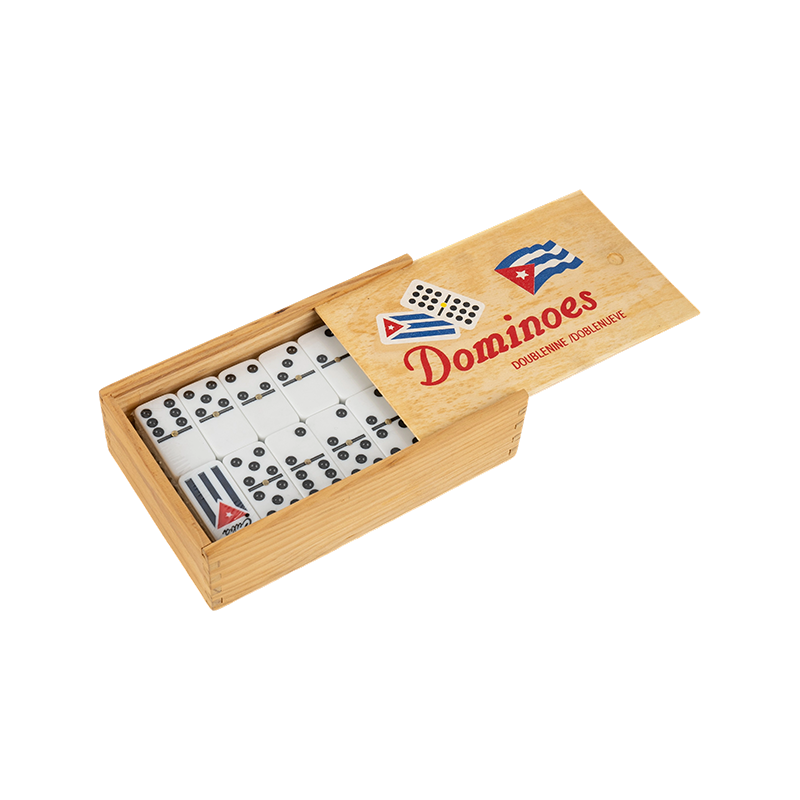 Traditional Cuban Double Nine Wooden Box DominoesA customizable Cuban-style double-nine set in a wooden box, presented for wholesale sourcing as a market-specific variation on familiar domino play.View Product →
Sets like this traditional Cuban double-nine in a wooden box show how a familiar game can be dressed for a different market without changing a single rule.
Play moves clockwise, one tile at a time, matching halves at either open end of the chain. Doubles go crosswise and may open extra directions. If you cannot play, draw or pass depending on the variant you agreed. When a hand empties or the table blocks, count the pips and start again.
Everything beyond that is local tradition — and that is exactly what makes the game worth keeping a set on the shelf for.

Mainly engaged in the manufacture and processing of dominoes and their matching dice and plastic products.
Phone:+86-189-5820-5377
Email: [email protected]
TEL:+86-574-8873-4255
Adress: Jindi Village, Jinjiayuan, Jinhu Town, Fenghua City, Ningbo, Zhejiang, China
