
 EN
 Deutsch
 Español
Why Rummy Tile Game can become a new generation of classic board game
Introduction: The charm of board games and the rise of Rummy Tile Game Historical background of traditional board games Board games, as part of human...

Ask players what dominoes are and you will hear a few different answers. For some, they are the first game learned as a child, with that satisfying click of plastic tiles on the kitchen table. For others, they are the heart of a long evening, whether the game is Mexican Train, Block, or a fast round of All-Fives.
At their core, dominoes are a family of tile-based games played with small rectangular pieces. Each tile, called a domino, has a line across its middle that splits the face into two square ends. Every end carries a number of spots, or pips, from zero to six in a standard set. The goal of nearly every domino game is the same: match numbers, play your tiles, and be the first to empty your hand.
Before we talk about games, it helps to understand the tile itself. A domino is longer than it is wide, which gives it that distinctive rectangular profile. The centre line, sometimes called the bar or the divider, splits the tile into two square halves. Each half can show a number of pips from zero to six on a standard double-six set. A half with no pips is called a blank.
Tiles are named by the pips on each end. The 3-5 tile, for example, has three pips on one end and five on the other. When both ends show the same number, the tile is a double: the 6-6 is the double-six, and the 0-0 is the double-blank. Each number also represents a suit, and suit awareness matters more than beginners expect. The more tiles of a suit remain unplayed, the harder that number becomes to match.
Dominoes are sold in sets named after their largest tile. A double-six set contains every combination of two numbers from zero to six, which comes to 28 tiles. A double-nine set expands that to 55 tiles, and a double-twelve set holds 91. The larger the set, the more players it can accommodate and the longer the games run.
| Set | Number of tiles | Highest pip | Best suited for |
|---|---|---|---|
| Double-6 | 28 | 6 | 2–4 players, family games |
| Double-9 | 55 | 9 | 4–6 players, Cuban dominoes |
| Double-12 | 91 | 12 | Mexican Train, larger groups |
| Double-15 | 136 | 15 | 8 or more players |
| Double-18 | 190 | 18 | Very large gatherings |
Most family games use a double-six set, and it is the ideal starting point for children and casual players. If you regularly play with four or more people, or want to try Mexican Train, move up to a double-nine or double-twelve.
 Classic Double Six Dominoes in a Red Iron BoxA traditional 28-tile double-six set in a durable red iron tin, ideal for family games and beginners. Easy storage and portability make it a practical choice for casual play.View Product →
Double-nine sets have a strong following in Caribbean dominoes, especially the traditional Cuban version, where four players play in fixed partnerships and the conversation is as lively as the scoring. Double-twelve sets are the standard choice for Mexican Train, a game that can absorb eight or even a dozen players, with everyone building their own line of tiles from a central hub. Double-fifteen and double-eighteen sets shine at large parties where nobody wants the fun to end.
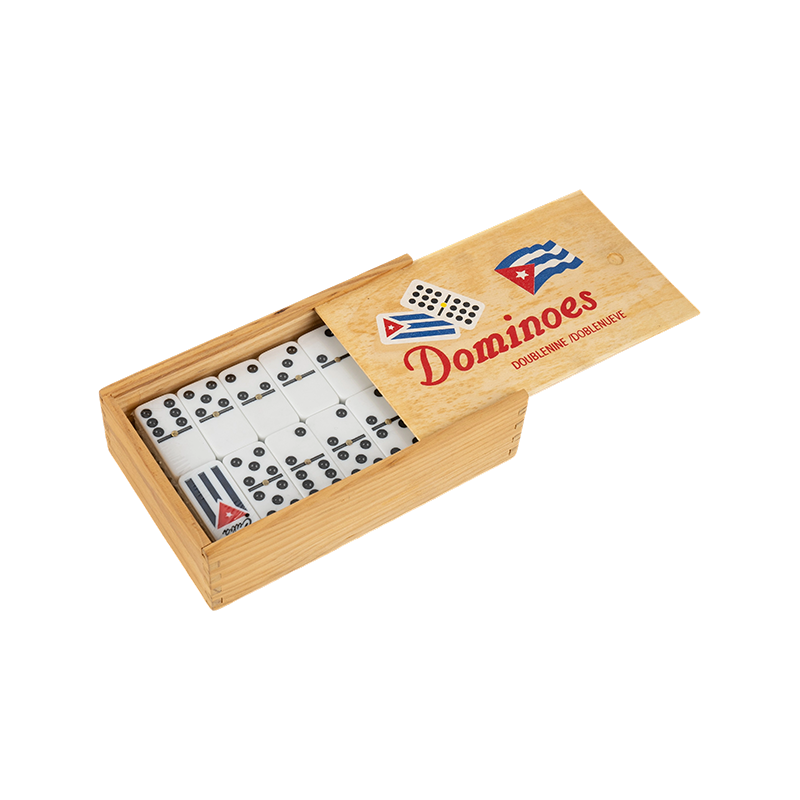 Traditional Cuban Double Nine Dominoes in Wooden BoxA 55-tile double-nine set with a classic Cuban design, housed in a wooden box. Perfect for Caribbean-style fixed-partnership games and valued as a collectible custom item.View Product →
Match the set to the game rather than the number on the box. Mexican Train needs double-twelve or larger. Cuban dominoes traditionally use a double-nine. A family that plays a quick round after dinner will be happiest with a double-six. We offer all of these sizes, along with custom colours and packaging, so you can build the set your group wants.
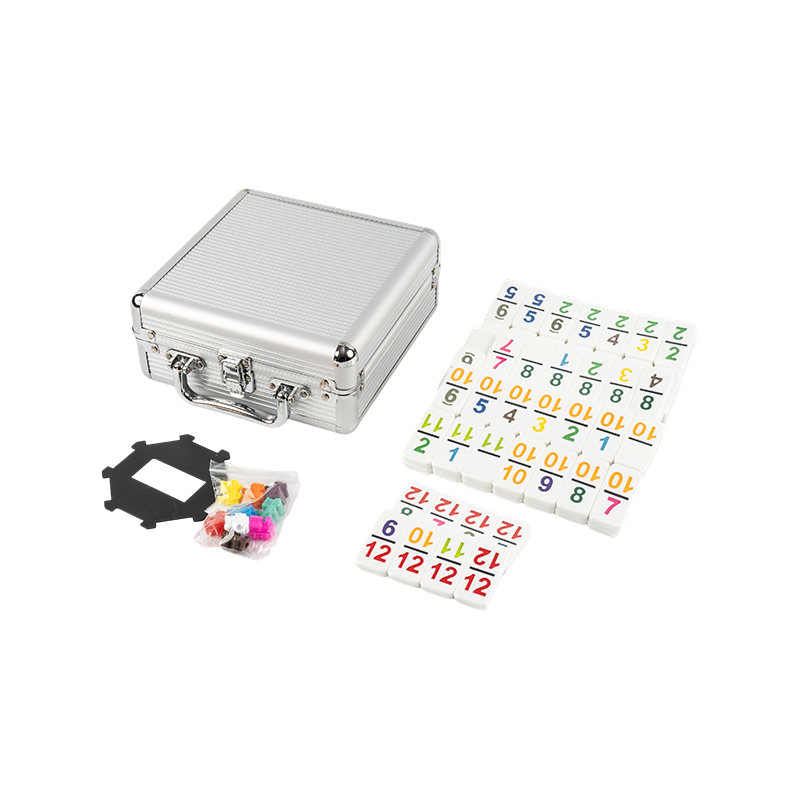 Double Twelve Aluminum Box Dominoes for Mexican TrainA 91-tile double-twelve set in an aluminum box, designed for Mexican Train and large multiplayer games. Customizable with a deluxe option, suitable for family gatherings.View Product →
Rules differ from game to game, but almost every version follows the same rhythm. The tiles are turned face-down and shuffled. Each player draws a hand, usually seven tiles in a two-player game, and the rest go into a face-down pile called the boneyard. The first player lays a tile face-up in the middle of the table. From then on, each turn means matching one of your tiles to an open end on the table.
Strategy grows quickly from this loop: keep the open ends unbalanced, force opponents to draw, and hold doubles until they hurt most. If you are new to the game, our guide to how to play Double-6 dominoes walks through the standard rules and a few tactics.
Part of the beauty of dominoes is how many games fit on one set of tiles.
Dominoes were once carved from bone, ivory, or dark hardwoods, and antique sets are still prized by collectors. Modern sets are almost always made from plastic or urea resin, which yields a smooth, dense, consistent tile that shuffles well and lasts for decades. Urea dominoes, the kind we make in our own factory, have a warm, solid feel, and the pips stay crisp long after a few hundred games.
We have produced urea dominoes in Ningbo since 2008, with more than 100 skilled workers and production teams that bring over ten years of experience to every order. Our mould range runs from classic double-six sets to oversized double-eighteen editions, and we regularly produce customised sets for game publishers, retailers, and event organisers. Tiles can be coloured, printed, or embossed with a logo, and packaging ranges from a simple paper box to a handsome tin or aluminium case. Read more about Ningbo Shuangfan Plastic Manufacturing on our company news page.
Choosing a set comes down to who will play, and where.
Dominoes have been around for centuries because the rules are easy to learn and the games are surprisingly deep. Whether you are buying a first set for family games night, adding a Mexican Train set to the club cupboard, or sourcing custom dominoes for your own product line, a well-made set makes every game better. Browse our catalogue to see the range we produce, from the classic double-six in a paper box to deluxe aluminium travel editions, and ask us about sizes, materials, or customisation — we are happy to help.

Mainly engaged in the manufacture and processing of dominoes and their matching dice and plastic products.
Phone:+86-189-5820-5377
Email: [email protected]
TEL:+86-574-8873-4255
Adress: Jindi Village, Jinjiayuan, Jinhu Town, Fenghua City, Ningbo, Zhejiang, China
