
 EN
 Deutsch
 Español
Why Rummy Tile Game can become a new generation of classic board game
Introduction: The charm of board games and the rise of Rummy Tile Game Historical background of traditional board games Board games, as part of human...

Dominoes is one of those games that looks almost too simple until you sit down and actually play it. Twenty-eight small tiles, a handful of dots, and suddenly the whole table is leaning in, counting open ends and deciding whether to block or draw. The basic dominoes game is exactly that experience: no board, no cards, no complicated setup, just tiles that click together and a rhythm that everyone picks up within a round or two.
We have been moulding dominoes in Ningbo since 2008, so we have watched plenty of first-timers open a fresh set. The rules below are the ones we usually teach at the table — short, practical, and just enough to get a real game going in about five minutes.
When people say basic dominoes, they almost always mean the classic double-six set. It holds 28 tiles, and each tile is divided into two square ends carrying zero to six pips. A blank end counts as zero, and the double-blank is a genuine tile, not a spare.
The whole game rests on one idea: match an end. A 4-2 tile can be played against any open 4 or any open 2 on the table. That single rule drives every version of the game, from a quiet two-player round to a loud family table on a rainy afternoon.
Bigger sets follow exactly the same logic, they simply carry more tiles and a higher top pip. If you are choosing a set for a specific crowd, this table is a quick reference.
| Set | Tiles in the set | Highest pip value |
|---|---|---|
| Double-six | 28 | 6 |
| Double-nine | 55 | 9 |
| Double-twelve | 91 | 12 |
| Double-fifteen | 136 | 15 |
| Double-eighteen | 190 | 18 |
For a first game, stay with double-six. Fewer tiles means shorter rounds, fewer decisions, and a much easier time spotting which ends are still open.
Setup takes under a minute once you have done it twice. Here is the order we use:
That version is a draw game, which is the friendliest starting point because nobody gets stuck. A block game works differently: every tile is dealt out, there is no boneyard, and a player who cannot move simply passes. Block games suit experienced tables and short, tense rounds.
The opening tile is placed in the middle of the table. From then on, the line grows from both ends, and the two outermost tiles are the only legal targets.
Two open ends means two chances to play, which is why a well-placed tile in the middle of a round can suddenly reopen the whole table. Beginners tend to dump their heaviest tiles first. A more reliable habit is to keep a spread of numbers in hand so you are never fully dependent on one pip value.
If you want the finer points, including how doubles affect the open ends and a few simple strategies, our guide to double-six rules and strategies goes deeper into the same game.
A round ends in one of two ways. Either someone plays their last tile — that is a domino — or the table is blocked and nobody can move.
When a player goes out, they collect the total pips still sitting in the other players' hands. A hand holding 3-5 and 6-6 gives away 20 points. When the game is blocked, the player with the lowest pip count in hand wins the round and scores the difference between their count and each opponent's count.
Most casual games run to 100 or 150 points across several rounds, which keeps a single unlucky deal from deciding everything. Keep a running score on paper or a phone note — small tally marks work just as well as anything else.
Once the basic game feels automatic, these are the natural next steps. All of them use the same tiles.
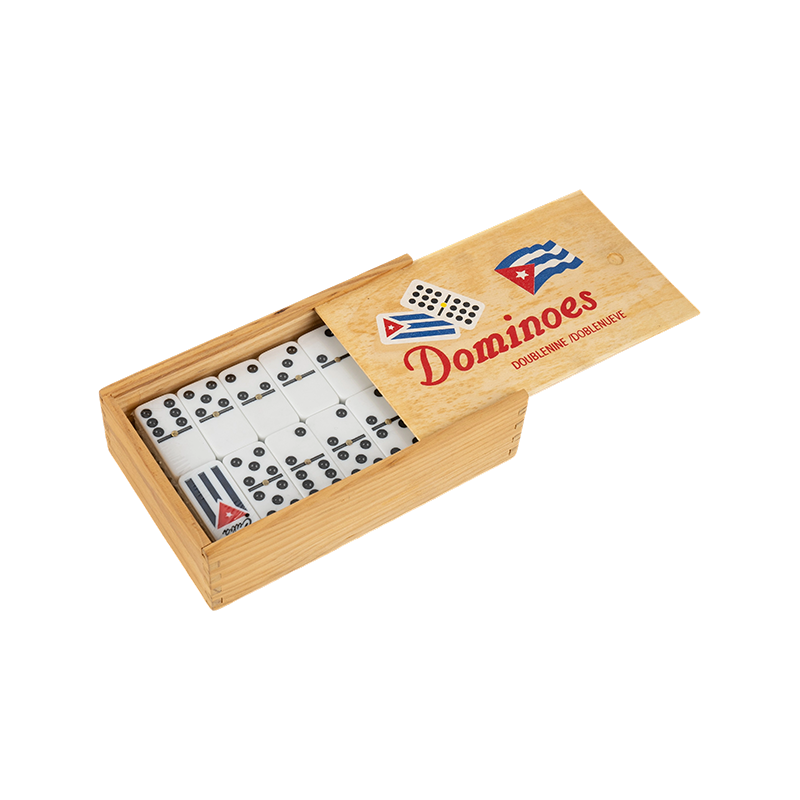 Traditional Cuban Double Nine Wooden Box DominoesA traditional Cuban-style double-nine set in a wooden box, offering a natural next step for players ready for a wider board.View Product →
The double-nine set is where many players naturally end up. The extra pips widen the board and make blocking far more interesting, and a wooden box keeps 55 tiles together between game nights.
Rules are free; tiles are not, so it is worth buying once. Three things matter more than any label on the box.
Material and weight. Urea resin tiles have a dense, slightly chalky feel that shuffles quietly and holds a crisp edge. Lightweight plastic tiles slide around and wear at the corners, which shows up quickly on a table that plays often.
Thickness and finish. A tile around 8 mm thick stands on edge without toppling and is comfortable to pick up. Pips should be moulded or printed deeply enough that they do not fade after a few hundred rounds.
Packaging that suits how you play. A paper box is fine for a shelf; a tin or a wooden box survives being carried to a friend's house. Our own line covers everything from compact paper-box sets to solid wood cases, because buyers ask for very different things depending on whether the set is for a living room or a retail shelf.
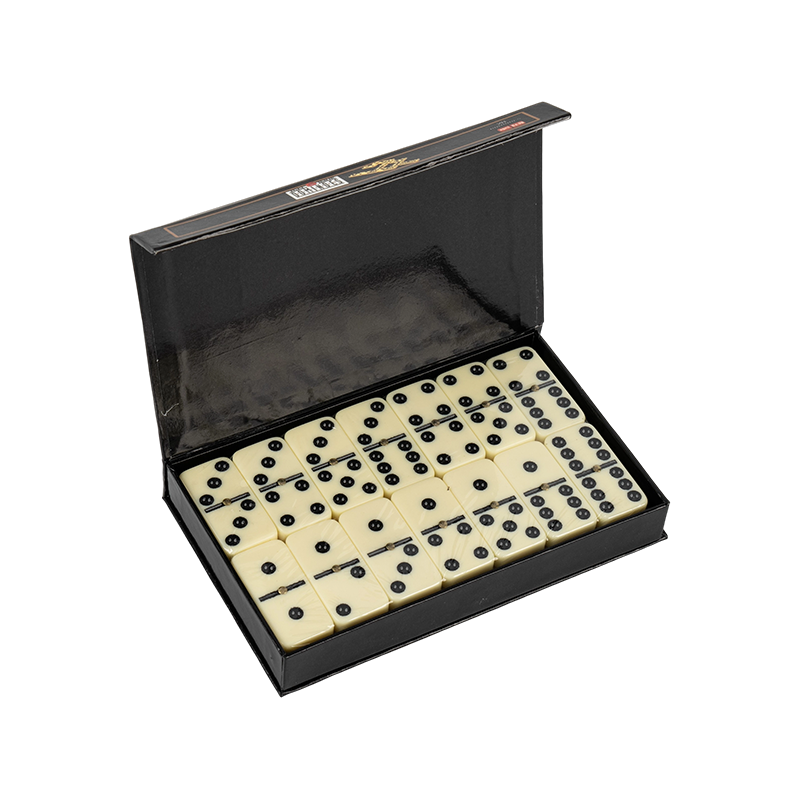 Classic Double Six Dominoes in Ivory Paper BoxA customizable double-six set in an ivory paper box, suited to shelf display and retail presentation when packaging needs to stay simple.View Product →
 Double Six Dominoes with Black Iron BoxA 28-tile double-six set with high-contrast black tiles and a matching iron storage box for family gatherings and carrying.View Product →
Both formats use the same 28-tile double-six core, so the game never changes — only the way the set travels. If you are stocking a shop or planning a gift, our double-six domino sets cover the full range of box types in one place.
No. A standard double-six set of 28 tiles is all the basic game requires. Anything larger is a variation, not a requirement.
The round is blocked. Everyone counts the pips left in their hand, the lowest count wins, and scoring follows the difference. Then the tiles are shuffled and the next round begins.
Yes, and comfortably. Matching ends is a simple visual task, and many families start with open hands and no scoring at all before adding the competitive layer.
The basic dominoes game has survived for centuries because it asks so little and gives back so much. A flat surface, a set of tiles, and three other people are enough for an evening.

Mainly engaged in the manufacture and processing of dominoes and their matching dice and plastic products.
Phone:+86-189-5820-5377
Email: [email protected]
TEL:+86-574-8873-4255
Adress: Jindi Village, Jinjiayuan, Jinhu Town, Fenghua City, Ningbo, Zhejiang, China
